Home & Tax Strategy
Section 01 | Buying, Building & Financing
Episode 04
Building a Home? Here's Why Tracking Your Cost Basis Matters
By Colleen Kamolnik
Building a Home? Here's Why Tracking Your Cost Basis Matters
If you've ever built a home, you know how quickly the expenses can add up.
Lumber, concrete, plumbing, electrical, permits, contractor payments. The list seems endless!
My husband and I are preparing to build our next home, and as we're gathering estimates and working through our construction budget, there's something I've been thinking about from the tax side.
Are we keeping track of everything that should count toward the cost of our home?
And I'm not just talking about staying within our construction budget.
I'm talking about something called your cost basis.
It might not sound particularly exciting, but understanding it now could make a difference in your taxes years down the road.
1. What Exactly Is Your Home's Cost Basis?
Think of your cost basis as your starting investment in the property for tax purposes.
When you purchase an existing house, your basis generally starts with the purchase price plus certain qualifying acquisition costs.
But when you build your home, you're essentially creating that basis from the ground up.
Your starting basis generally includes the cost of your land, the money spent constructing the house, and other qualifying expenses associated with the project.
And here's why that matters.
Your home's adjusted cost basis helps determine how much gain you have when you eventually sell.
The higher your legitimate, documented basis, the less gain you may have to report.
Now, that doesn't necessarily mean you'll owe taxes when you sell. Many homeowners qualify for the primary residence capital gains exclusion.
But not everyone qualifies, and not everyone's gain falls entirely within the exclusion.
That's why these records are worth keeping.
2. Which Construction Expenses Count Toward Your Cost Basis?
This is where I really encourage people to pay attention.
When you're building a home, quite a few expenses may be included in your property's tax basis.
Examples generally include:
The purchase price of your land
Lumber and other building materials
Labor paid to contractors and subcontractors
Architectural and design fees
Building permits
Construction equipment rentals
Inspection fees
Utility connections
Certain legal fees directly related to construction
Qualifying land and site improvements
Depending on the expense, costs such as driveways, grading, wells, and septic installations may also become part of the property's basis or be tracked as separate capital improvements.
The key is documenting what you actually spent and what each expense was for.
And here's something important.
Don't count the same expense twice.
If your general contractor's invoice already includes materials and labor, you wouldn't separately add those same costs again.
3. Let's Look at an Example
Throughout this series, we're using a simple homebuilding example.
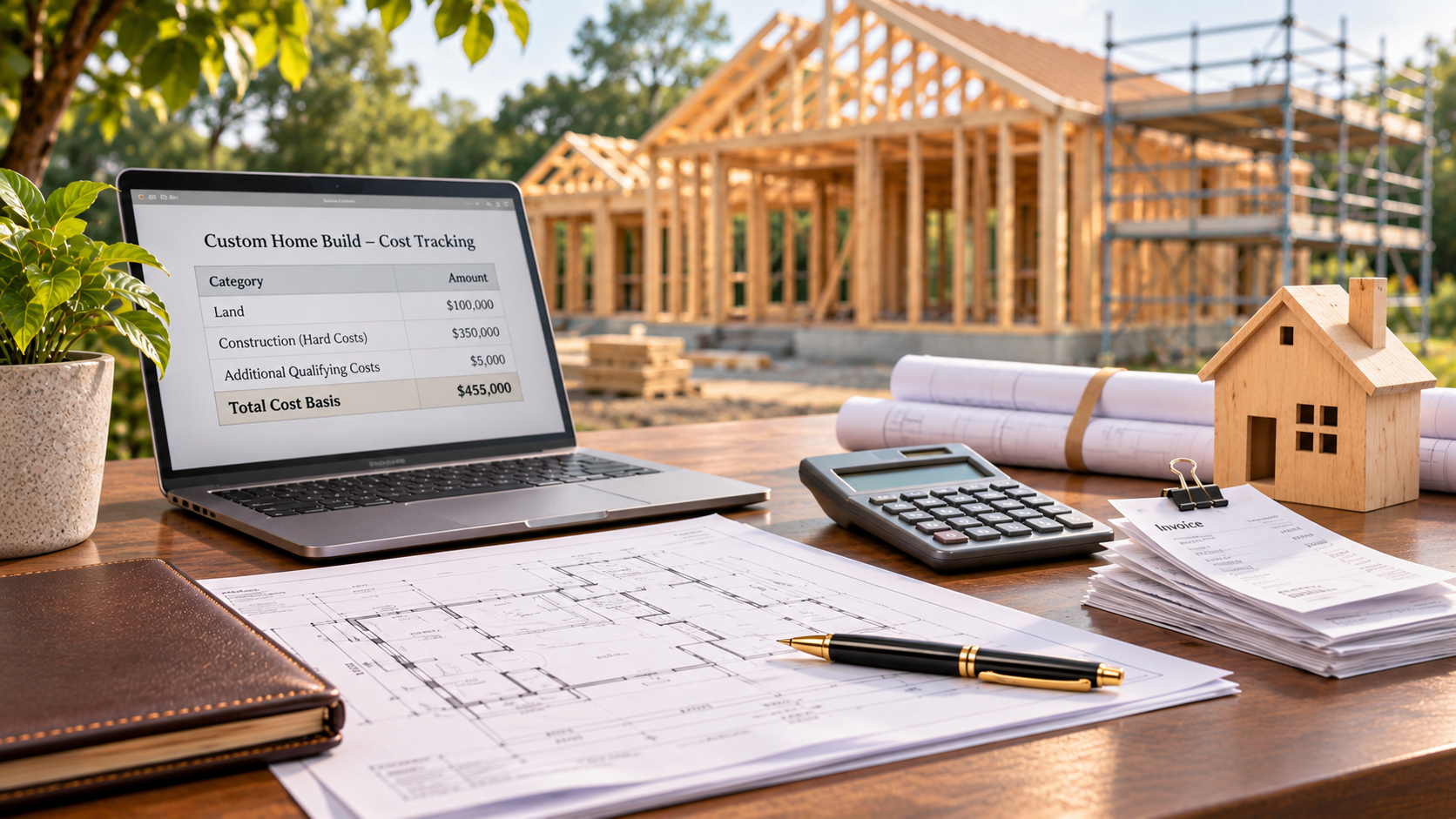
Let's say you purchase land for $100,000.
You spend $350,000 constructing your home.
And you incur another $5,000 in qualifying costs that weren't already included in your construction total.
Here's what that looks like:
Land purchase $100,000
Home construction $350,000
Additional qualifying costs $5,000
Total starting cost basis $455,000
Your starting tax basis could be $455,000, assuming all of those expenses qualify and no other adjustments are required.
Now let's say you eventually sell the property for $650,000.
Before selling expenses, future basis adjustments, and any available home-sale exclusion, your gain would be:
$650,000 - $455,000 = $195,000
That $195,000 isn't necessarily taxable.
Depending on your circumstances, you may qualify to exclude some or all of the gain.
But you need to know your adjusted basis to calculate the gain correctly in the first place.
And imagine trying to reconstruct fifteen years of construction and improvement expenses when you're getting ready to sell!
That's not something I'd want to do.
4. What If You're Building the House Yourself?
This is especially important for owner-builders.
Maybe you're acting as your own general contractor, hiring subcontractors directly, purchasing materials, or even doing some of the construction work yourself.
The tax treatment is worth understanding.
You generally cannot include the value of your own unpaid labor in your home's cost basis.
Let's say you spend several weekends painting your house.
You can't decide your time was worth $5,000 and add that amount to your basis.
But the qualifying paint, supplies, and labor you actually paid for may count.
The IRS makes a distinction between the value of your personal time and the actual costs incurred to construct the property.
So even if you're doing much of the work yourself, keep those receipts!
5. Your Construction Loan Isn't Your Cost Basis
Here's another distinction people sometimes miss.
The amount you borrow to build your home isn't necessarily the same as its cost basis.
Let's say your construction loan is $350,000.
That doesn't automatically mean your home's basis is $350,000.
Remember our example?
You also purchased the land for $100,000 and incurred another $5,000 in qualifying expenses.
Your potential starting basis is $455,000, regardless of whether you financed those costs or paid for them with cash.
And as you pay down your mortgage, those principal payments don't increase your basis again.
The qualifying expenditures establish the basis, not the amount of debt remaining on the property.
6. What Happens When You Renovate Later?
Your starting basis isn't necessarily the number you'll use when you sell.
It's called your adjusted basis because certain events can increase or decrease it over time.
For example, qualifying capital improvements may increase your basis.
Think of things like adding a bedroom, building an addition, or making other substantial improvements.
On the other hand, certain adjustments, such as depreciation allowed or allowable for business or rental use, may reduce your basis.
That's why you should continue tracking major improvements even after construction is complete.
And we'll talk much more about that in the Home Improvements and Renovations section of this series.
7. How Long Should You Keep Your Construction Records?
My recommendation?
Keep them for as long as you own your home, and through the applicable tax record-retention period after you sell.
I would establish a digital folder from the very beginning.
Here's what I'd keep:
Land purchase closing documents
Contractor agreements and paid invoices
Building material receipts
Architectural and engineering invoices
Permit and inspection records
Utility installation and site improvement expenses
Construction loan and closing documents
Records of future capital improvements
A simple spreadsheet can make this much easier.
Track the date, vendor, description, amount, and category of each expense. Then save the supporting invoice or receipt.
And if you're working with a construction lender that requires draw schedules, you may already have a useful starting point for organizing those costs.
Just remember that a lender's construction budget and your tax basis aren't necessarily identical.
My Biggest Takeaway
If you're preparing to build a house, don't wait until you're finished to start tracking your expenses.
Good recordkeeping now can help establish your home's tax basis and potentially reduce your taxable gain when you sell.
And even if you expect to qualify for the primary residence capital gains exclusion, it's still worth maintaining accurate records.
Tax rules can change. Your plans can change. And your property may eventually become a rental or be used for business.
Having good documentation gives you options.
For my husband and me, this is something we're thinking about before construction even begins.
And if you're planning a build, I'd encourage you to do the same.
Coming Next: Mortgage Points
When you're financing a home, your lender may offer you the option to pay mortgage points to lower your interest rate.
But is that actually a good financial decision?
And are those points tax deductible?
That's what we're covering next in our Home & Tax Strategy series.
Follow the full series at joltstrategies.com/blog.
IRS references
These support the article's treatment of construction costs, owner labor, adjusted basis, and home sales.
IRS Publication 551: Basis of Assets. Includes construction costs such as land, labor, materials, architect fees, and building permits.
IRS Publication 530: Tax Information for Homeowners. Addresses construction basis, home improvements, and personal labor.
IRS Publication 523: Selling Your Home. Explains adjusted basis, calculating gain, and home-sale tax treatment.
About JOLT Strategies
JOLT Strategies provides outsourced accounting, tax strategy, and advisory services to growing businesses and their owners. We believe good tax planning should happen throughout the year, not just when it's time to file a return.
This article is for general educational purposes and does not constitute individualized tax advice. Tax treatment depends on your circumstances and applicable law.
Related JOLT services
READY FOR THE NEXT STEP?