


Why Mixing Business and Personal Expenses Is Hurting Your Profit (and Your Sanity), For Real Estate Agents

Picture this, It's 11 PM on a Tuesday, you're sitting at your kitchen table with bank statements scattered everywhere, trying to figure out whether that $47 dinner charge was the client meeting at Olive Garden or date night with your spouse. Sound familiar?
If you're nodding your head, you're definitely not alone. At JOLT Strategies, we see this scenario play out with real estate agents every single day. The truth is, mixing your business and personal expenses isn't just creating paperwork headaches, it's actively costing you money and stealing your peace of mind.
Let's talk about why this seemingly harmless habit is hurting your bottom line and what you can do about it (spoiler alert, it's easier than you think).
The Real Cost of Financial Chaos
When you started your real estate career, you probably did what most agents do, used your personal checking account and credit card for everything. One account, one card, simple, right? Wrong.
What starts as convenience quickly becomes a financial nightmare that impacts every aspect of your business.
Here's what's really happening when you mix your money:
You're Painting a Target on Your Back for the IRS
The IRS has a fancy term for mixing business and personal expenses, "commingling." And guess what? It's one of their favorite red flags for triggering audits. When auditors see mixed finances, they automatically assume there's something fishy going on.
During an audit, the burden of proof is entirely on you. You'll need to dig up receipts, explain every transaction, and prove that your business expenses weren't actually used for personal purposes. When your accounts are already mixed, this becomes nearly impossible to do convincingly.
Think about trying to prove that the office supplies you bought six months ago weren't for your kids' school projects, or that the gas you claimed as a business expense wasn't for your family vacation. It's a nightmare scenario that could have been completely avoided.
Your Accounting Bills Are Through the Roof
Here's something most agents don't realize, when your bookkeeper or CPA has to sort through your mixed-up transactions, you're paying extra for that detective work. Separating commingled expenses falls outside the scope of normal bookkeeping services, which means additional hourly charges.
We've seen agents pay hundreds of extra dollars each month just because their accountant had to play "business expense or personal expense?" with every transaction. That money could have stayed in your pocket with a simple system change.

You're Losing Money on Legitimate Deductions
When your finances are a mess, two things happen, you either miss legitimate business deductions because you can't find them in the chaos, or you accidentally claim personal expenses as business ones (hello, audit risk!).
Both scenarios cost you money. Missing real deductions means you're overpaying on taxes. Claiming incorrect deductions means potential penalties and interest if you get caught.
The Sanity Factor: Why Your Mental Health Matters
Let's be honest, real estate is already stressful enough. Between managing clients, chasing leads, handling contracts, and dealing with financing drama, the last thing you need is financial chaos adding to your stress load.
Decision-Making in the Dark
When your business and personal expenses are mixed together, you have no clear picture of how your business is actually performing. Are your marketing efforts paying off? Should you cut back on certain expenses? Are you actually making a profit?
You can't make smart business decisions when you don't have clean data. It's like trying to navigate without GPS, you might eventually get where you're going, but you'll waste a lot of time and gas along the way.
The Monthly Panic Attack
Every month when it's time to review your finances (or avoid reviewing them), you feel that familiar knot in your stomach. Instead of confidently looking at your numbers, you're dreading the mess you know is waiting for you.
This financial anxiety doesn't just affect your bookkeeping, it impacts your confidence in client meetings, your ability to invest in growth opportunities, and your overall relationship with money.
Time You Can't Afford to Waste
As a real estate agent, your time should be spent on income-producing activities, generating leads, meeting clients, showing properties, and closing deals. Every minute you spend sorting through financial chaos is a minute you're not making money.
The hours you lose each month trying to separate business from personal expenses add up quickly. That's time you could spend prospecting, following up with past clients, or actually having a life outside of work.
The Simple Solution That Changes Everything
Ready for some good news? Fixing this problem is actually pretty straightforward. You don't need a business degree or fancy software, just a commitment to keeping things separate from day one.
Step 1: Open a Business Checking Account
This is non-negotiable. Your business needs its own checking account, and it should be used exclusively for business transactions. All your commission income goes in, all your business expenses come out. Simple as that.
When choosing a bank, look for:
Low or no monthly fees for business accounts
Free online banking and mobile check deposits
Good customer service (you'll need it when you're dealing with large commission deposits)
Multiple branch locations if you prefer in-person banking
Step 2: Get a Business Credit Card
A dedicated business credit card serves multiple purposes. It helps build your business credit history, often comes with better rewards than personal cards, and creates a clear paper trail for all your business expenses.
Use this card for everything business-related, gas for showings, client lunches, marketing materials, professional development, office supplies, everything.
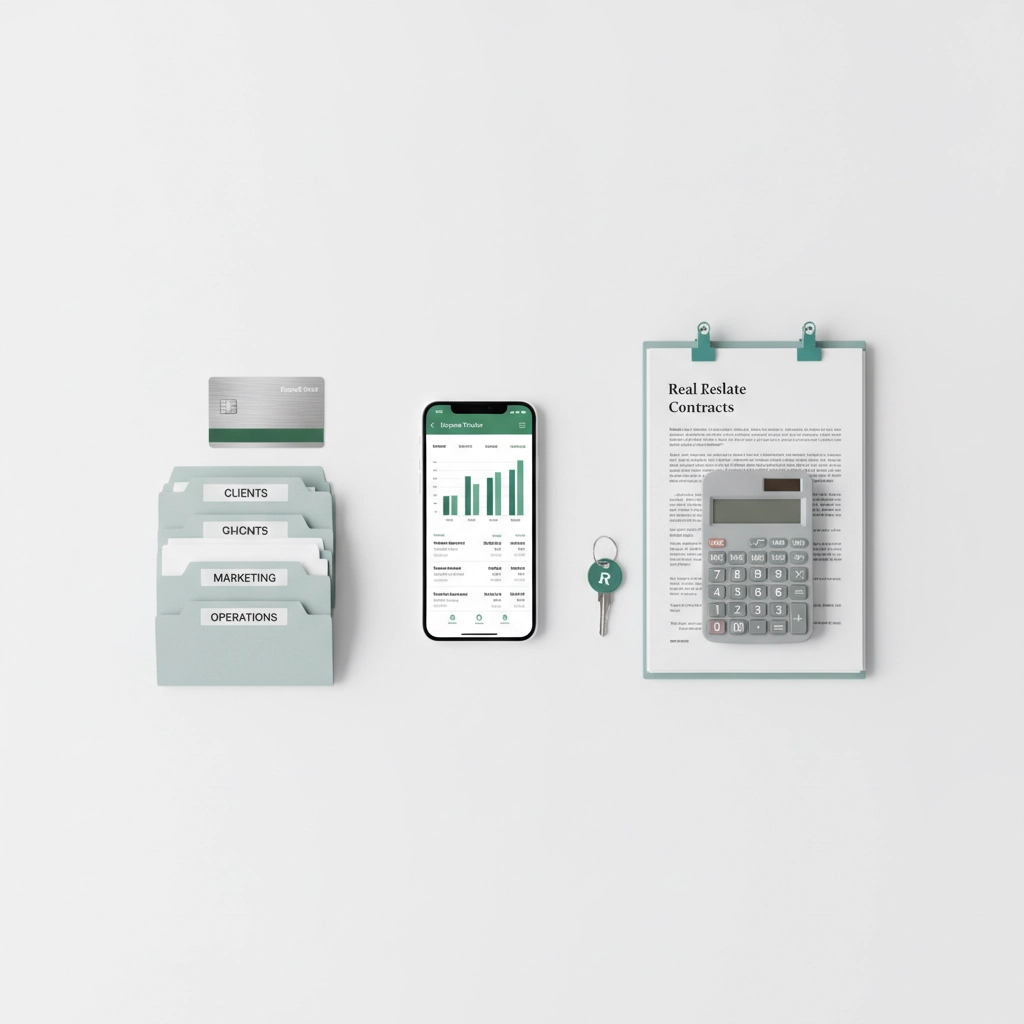
Step 3: Pay Yourself Like the Business Owner You Are
Here's where many agents get confused. Once your commission checks hit your business account, you don't just leave all that money there. You pay yourself by transferring money from your business account to your personal account.
This transfer is called an "owner's draw" if you're a sole proprietor or "distributions" if you have an LLC. The amount and frequency are up to you, weekly, bi-weekly, or monthly transfers all work fine.
Step 4: Track Everything from Day One
Don't wait until tax time to get organized. Set up a simple system to track your expenses as they happen. This could be as basic as taking photos of receipts with your phone or as sophisticated as accounting software that syncs with your accounts.
Popular options for real estate agents include:
QuickBooks Online (designed for 1099 contractors)
Wave (free option with good basic features)
FreshBooks (user-friendly interface)
Excel or Google Sheets (if you prefer manual tracking)
Making It Stick: Your New Financial Habits
Changing your money habits isn't always easy, especially when you're busy growing your business.
Here are some practical tips to make the transition smoother:
Use the "When in Doubt" Rule
If you're ever unsure whether an expense is business or personal, err on the side of caution and use your personal account. It's better to miss a small deduction than to claim something inappropriate.
Review Weekly, Not Monthly
Spend 15 minutes each week reviewing your business transactions. It's much easier to remember what that $23 charge was for when it happened three days ago versus three weeks ago.
Automate What You Can
Set up automatic transfers for your regular business expenses like MLS dues, professional memberships, and software subscriptions. This reduces the chance of accidentally using your personal card.
Keep It Simple
Don't overcomplicate things. The goal is clean separation, not perfect categorization. You can always adjust your system as your business grows and evolves.

Real Estate-Specific Considerations
As a real estate agent, you have some unique financial situations that other businesses don't face:
Commission Timing
Your income is irregular, which makes budgeting tricky. Having separate accounts actually helps with this because you can see exactly how much business income you have available versus your personal expenses.
1099 Status
Most agents are independent contractors, which means you're responsible for your own taxes, including self-employment tax. Clean financial records make quarterly tax payments much easier to calculate.
Professional Image
Nothing says "professional" like having a business account for your real estate activities. It shows clients and other professionals that you take your business seriously.
When You're Ready for the Next Level
Once you've mastered the basics of financial separation, you might want to consider more advanced strategies:
Monthly Financial Reviews
Schedule time each month to review your profit and loss, track your key performance indicators, and plan for upcoming expenses.
Quarterly Tax Planning
Instead of scrambling at year-end, review your tax situation quarterly to avoid surprises and maximize deductions.
Professional Bookkeeping Support
As your business grows, consider hiring a bookkeeper who understands real estate. They can handle the day-to-day transaction categorization while you focus on what you do best, selling real estate.
Your Financial Fresh Start
Here's the bottom line, separating your business and personal expenses isn't just about following rules or making your accountant happy. It's about taking control of your financial life so you can focus on building the real estate business of your dreams.
You don't need to be a financial expert to implement these changes. You just need to start. Open that business account this week. Get that business credit card. Set up a simple tracking system.
Your future self will thank you when tax time rolls around and instead of scrambling through bank statements, you're confidently reviewing clean, organized records. Better yet, you'll sleep better knowing exactly how your business is performing and where your money is going.
At JOLT Strategies, we help real estate agents just like you take control of their finances without the overwhelm. We know you didn't get into real estate to become a bookkeeper, you got into it to help people find their dream homes and build wealth for your family.
Ready to ditch the financial chaos for good? Let's set up a system that works for your real estate business. Visit our website to schedule your financial organization consultation. Because you deserve to keep more of what you earn, and actually know how much that is.
Comments