


When It Is Time for a Real Estate Professional to Become an S-Corp (and What That Really Means)

If you're crushing it in real estate and your income is growing, you've probably heard other agents casually mention, "You should become an S-Corp , it'll save you money!" And honestly? They're not wrong. But here's the thing, there's way more to it than just filing some paperwork and calling it a day.
At JOLT Strategies, we help agents like you figure out if an S-Corp actually makes sense for your specific situation. Because let's be real , what works for your friend who's selling luxury homes might not be the right move for where you are right now.
So let's break it down in plain English, shall we?
What's Really Going On Here?
Think of it this way: right now, as a sole proprietor, you're basically telling the IRS, "Hey, all this money I made? Yeah, that's just me being me." Every dollar gets reported on your personal tax return, and you're paying:
Regular income tax (just like everyone else)
Self-employment tax at 15.3% (which covers Social Security and Medicare)
That self-employment tax? It's a big chunk of change when you're doing well.
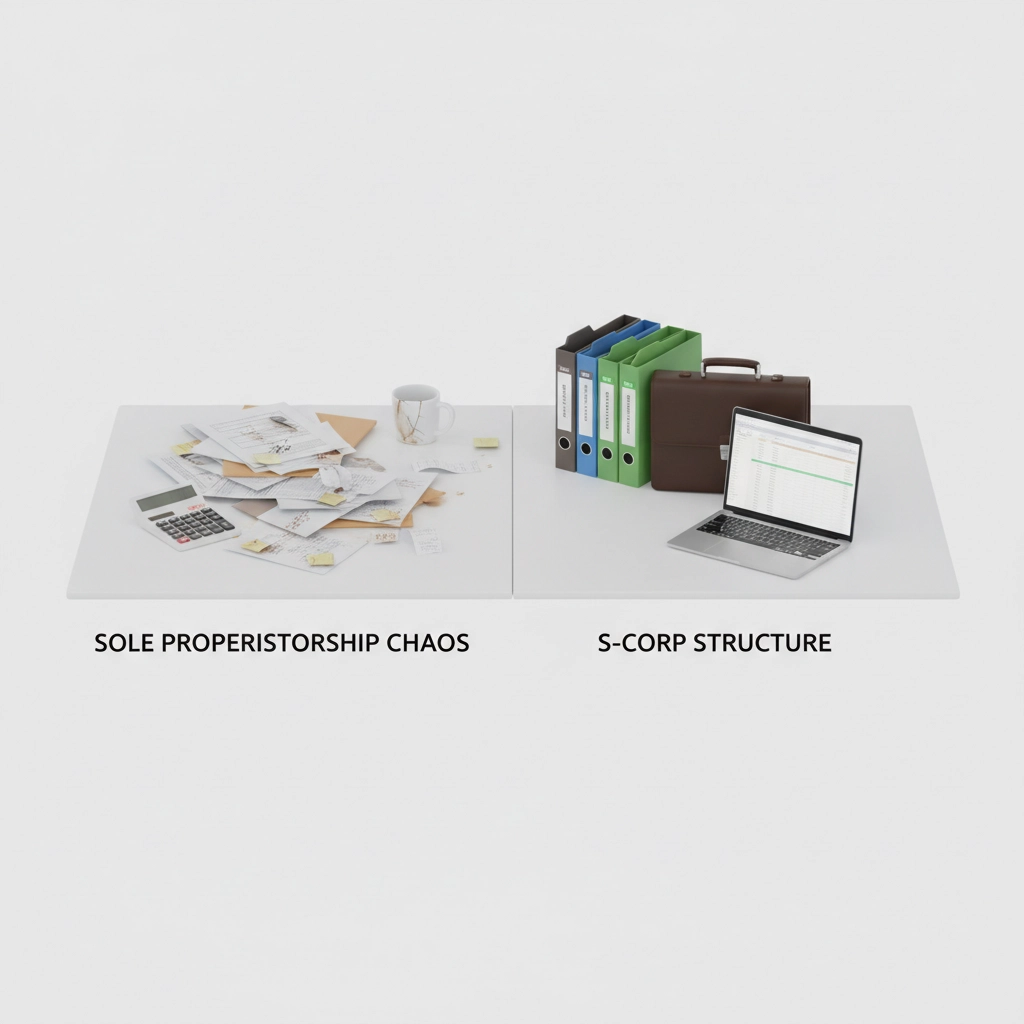
Now, an S-Corp flips the script. Instead of being just "you," you become both the owner AND an employee of your own business. Wild, right?
Here's how it works:
You pay yourself a reasonable salary (yes, you have to run payroll for yourself)
That salary gets hit with the usual payroll taxes
Any leftover profit? That comes to you as a "distribution" : and here's the kicker : distributions don't get slammed with self-employment tax
That's where those tax savings everyone's talking about come from.
When Does This Actually Make Sense?
Here's where the rubber meets the road. An S-Corp isn't a magic wand you wave when you sell your first house. The general rule most accountants throw around is that you should be netting somewhere between $60,000 and $80,000 per year consistently before it makes sense.
But here's what we've found working with real estate agents: if you're making $40,000 or more in net income that's subject to self-employment tax, you're in the conversation zone. Below that? The admin headaches probably aren't worth the savings yet.
Let's do some quick math to show you what we mean. Say you're pulling in $100,000 in net income:
As a sole proprietor: You're paying about $15,300 in self-employment tax on the whole amount.
As an S-Corp: You might pay yourself a $50,000 salary and take $50,000 as distributions. Now you're only paying self-employment tax on that $50,000 salary : cutting your self-employment tax roughly in half.
That's real money back in your pocket.
The Sweet Perks You Get
Beyond the tax savings (which, let's be honest, are pretty great), there are some other benefits that might surprise you:
You Look More Professional "Smith Real Estate, Inc." just hits different than "Jane Smith, Realtor." Clients and other professionals in the industry see you as a more established business. It's not everything, but it definitely doesn't hurt.
Liability Protection Gets Real When you incorporate, there's actual legal separation between you personally and your business. If something goes sideways with a client or deal, your personal assets have better protection. (Though you'll still want good insurance : don't get lazy here.)

Retirement Planning Opens Up As an employer (even of yourself), you get access to some pretty sweet retirement plan options. Solo 401(k)s and SEP IRAs become available, and you can potentially sock away more money tax-deferred than you could before.
Less Audit Risk This one's kind of a nice bonus: S-Corps historically get audited way less than individual returns. We're talking about 0.06% versus 0.22% : not huge numbers either way, but hey, who wants to deal with an audit?
Some Cool Tax Strategies Here's a fun one: you can rent your home to your S-Corp for up to 14 days a year. The corporation gets to deduct the rent, and you get the income tax-free. Perfect for those home office meetings or client events you host.
What You're Signing Up For (The Real Talk)
Let's not sugarcoat this : an S-Corp isn't free money. It comes with real responsibilities that you can't just ignore:
Payroll Is Now Your Life You have to run actual payroll for yourself. That means quarterly reports, tax withholdings, and all the fun stuff that comes with being an employer. You can outsource this (and honestly, you probably should), but it's still something that has to happen like clockwork.
Your Books Need to Be Squeaky Clean No more throwing business receipts in a shoebox and hoping for the best. You need separate bank accounts, proper record-keeping, and documentation for everything. The IRS takes S-Corps more seriously, so you need to take your bookkeeping more seriously too.

You Can't Lowball Your Salary Remember that "reasonable salary" thing? The IRS isn't messing around. You can't pay yourself $20,000 and take $130,000 in distributions without raising some serious red flags. Your salary needs to reflect what you'd pay someone else to do your job.
More Forms, More Compliance Get ready for additional tax forms and compliance requirements. It's not rocket science, but it's definitely more involved than filing a Schedule C with your personal return.
Making the Call: Timing and Decision Points
If you're consistently hitting that $40,000+ net income mark and you're not afraid of a little extra admin work (or you're willing to pay someone to handle it), the math probably works in your favor.
The best time to make the switch? January 1st. Starting at the beginning of the tax year makes everything cleaner from a record-keeping perspective. But don't let that stop you if you're mid-year and the numbers make sense : you can make it work.
Here's what we always tell our clients: this isn't about ego or looking fancy. It's a business decision based on math. If the tax savings justify the extra costs and complexity, do it. If not, wait until they do.
Your Next Steps
Look, we get it. This stuff can feel overwhelming when you're trying to focus on selling houses and building your business. The good news? You don't have to figure this out alone.
At JOLT Strategies, we've walked dozens of real estate agents through this exact decision. We'll crunch your numbers, explain what makes sense for your situation, and if you decide to move forward, we'll handle all the setup and ongoing compliance.
We take care of:
Tax savings analysis (so you know exactly what you're looking at)
Payroll setup and management (because who has time for that?)
Ongoing bookkeeping and compliance (keeping the IRS happy so you can focus on clients)
Ready to stop guessing and start saving? Let's have a conversation about whether S-Corp status makes sense for your real estate business. Book your free consultation and we'll walk through your specific situation together.
Because here's the thing : the best financial decision is the one that's right for YOU, not your neighbor or that agent in your office who loves to give advice. Let's figure out what that looks like.
Comments